If there is one thing I have learned after years in the clothing industry, it is this: children’s clothing sizes look simple on the tag, but they are rarely simple in real life. One child may wear a size 5 in one brand and a size 6 in another. Another may technically match the age on the label, yet the sleeves are too short or the waist feels too loose.
That is exactly why so many parents end up guessing. And honestly, guessing is what causes most sizing mistakes.
The good news is that children’s clothing sizes become much easier once you stop treating age as the only guide and start looking at what really matters: height, weight, body proportions, garment type, and brand fit. Official size charts from major children’s retailers consistently rely on height and weight first, then refine the fit with measurements like chest, waist, and inseam.
In this guide, I’ll walk you through how I recommend approaching kids’ sizing step by step, so you can choose the right fit with more confidence and far less trial and error.
Children’s Clothing Size Chart
A children’s clothing size chart is one of the most useful tools you can rely on when shopping for kids. In my experience, it helps far more than guessing by age alone. A good size chart gives you a clearer picture of how a brand matches clothing sizes to a child’s height, weight, waist, and sometimes inseam, which makes sizing decisions much more accurate.
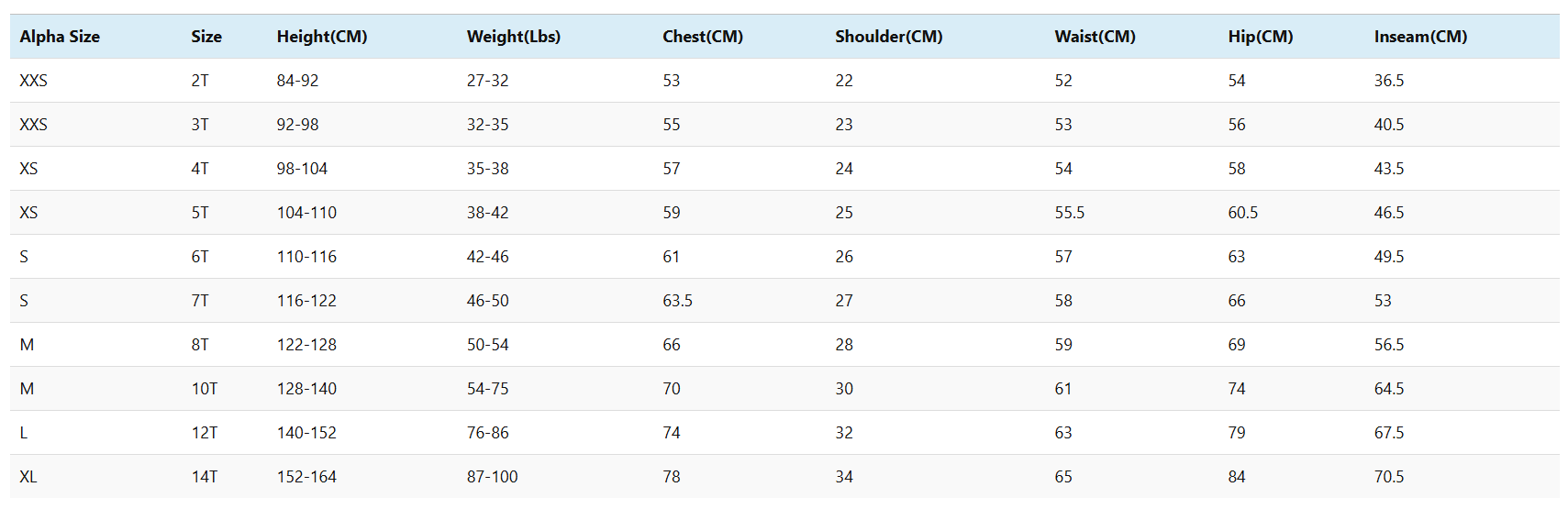
Source: HAPA
Why Children’s Clothing Sizes Are So Confusing
Age-based sizing is only a starting point
A lot of parents naturally begin with age. It seems logical. If your child is four years old, size 4 should fit, right?
In practice, not always.
Age-based sizing is useful only as a rough entry point. Children of the same age can differ a lot in height, build, torso length, leg length, and even how they carry weight. That is why age alone often gets you close, but not close enough. Retail size guides for kids consistently tell shoppers to measure the child and compare those measurements against the chart, rather than relying on age alone.
Different brands fit on different blocks
This is something many parents don’t realize until they have already placed a few disappointing orders: children’s sizing is not fully standardized across brands.
One brand may design for a slimmer frame. Another may build in more room at the waist or seat. Some labels lean fashion-forward and cut trimmer. Others are more generous because they prioritize comfort, layering, or longer wear. Even within a single size number, the intended fit can vary.
From an industry point of view, this is normal. Brands do not all develop garments from the exact same fit model or target customer profile. So when parents say, “My child is always a size 6,” I usually tell them to think of that as a habit, not a rule.
Baby, toddler, and kids’ sizes are not built the same way
The biggest confusion often happens around transition sizes, especially when a child is close to age two.
For example, 24M and 2T are often treated as interchangeable, but they are not always cut the same. Carter’s explains that 24 months tends to keep more baby-friendly proportions, often with extra room for diapers and a rounder fit, while 2T is more toddler-shaped and more aligned with independent dressing and potty training.
That may sound like a small detail, but in actual fit, it matters. A child can technically “fit” both on paper and still be more comfortable in one than the other.
What Actually Matters Most When Choosing Children’s Clothing Sizes
Height usually matters more than age
If you want my honest shortcut after years of looking at fit issues, it is this: start with height.
Height tends to be the fastest way to narrow down the right size because it affects total garment proportion. If a child is tall for their age, tops may ride up, jackets may feel short, and pants may suddenly look cropped even if the waist is fine. That is why many official children’s size charts place height and weight at the center of sizing guidance.
In my experience, if age and height point to different sizes, height is often the more useful guide for tops, dresses, outerwear, and one-piece garments.
Weight helps confirm overall fit
Weight matters too, but usually in a different way.
If height tells you the likely size range, weight often helps you decide whether the child will need a more relaxed or more fitted interpretation of that size. For children who are broader through the middle or have a fuller build, weight can become especially important when you are shopping for pants, uniforms, woven dresses, or structured jackets.
When height and weight do not land in the same size box, I usually advise parents to think about the garment category before deciding which side to prioritize.
Chest, waist, and hips fine-tune the result
Once you are between two possible sizes, body measurements become the tie-breaker.
Chest helps most with tops, sweaters, jackets, and dresses. Waist matters heavily for pants, skirts, shorts, and anything with a defined waistband. Hips can be helpful for leggings, fitted bottoms, and some dress silhouettes. Inseam becomes particularly important when a child is tall and slim, because waist alone may suggest one size while leg length clearly needs another. Major size guides for kids often include waist and inseam specifically for this reason.
How to Measure a Child Correctly Before Buying Clothes
What you need before you start
You do not need a complicated setup. A soft measuring tape is enough. I also suggest lightweight clothing, bare feet, and a note on your phone so you can save measurements for later.
If you measure over a puffy sweatshirt or with shoes on, the results will be off. Not dramatically, maybe, but enough to push you into the wrong size, especially if your child is already between sizes.
How to measure height
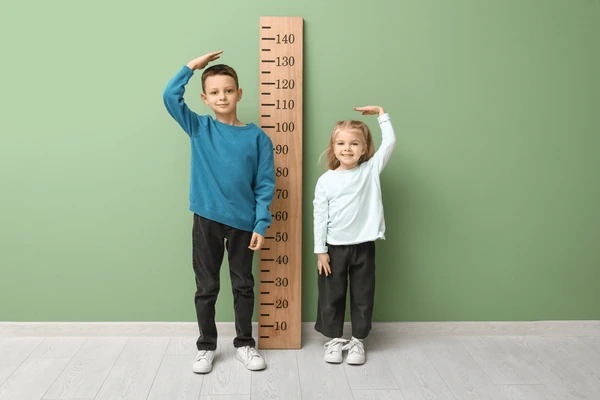
For toddlers and older children, have them stand straight against a wall without shoes. Heels should be touching the floor, posture natural, chin level. Measure from the top of the head to the floor.
For babies who cannot stand yet, measure length while they are lying flat, keeping the body as straight as possible. It does not have to be perfect to the millimeter. The goal is to get a realistic body measurement you can compare to the chart.
How to measure chest, waist, and hips
For chest, wrap the measuring tape around the fullest part of the chest, keeping it level and snug but not tight.
For waist, measure around the natural waistline. If you are unsure where that is, it is usually the narrowest part of the torso, not where low-rise pants happen to sit.
For hips, measure around the fullest part of the seat and hip area. This is not always necessary for every purchase, but it becomes useful when you are buying fitted bottoms or dresses with less give.
How to measure inseam and sleeve length
For inseam, measure from the upper inner thigh down to the ankle or to the point where you want the pant to end.
For sleeve length, measure from the shoulder point down to the wrist, or compare with a garment you already know fits well.
This is one of my favorite practical shortcuts: when parents already own a pair of pants or a jacket that fits beautifully, measuring the garment itself can save a lot of guesswork.
Common measuring mistakes I see all the time
The most common mistakes are simple.
Parents measure over bulky clothes. They pull the tape too tight because they assume it should be fitted. Or they rely on measurements taken months ago, even though kids can change quickly. Children’s Place notes that baby growth can move fast enough that both height and weight need to be checked regularly for accurate fit.
In real life, the best measurement is not the “perfect” one. It is the recent one.
How to Read a Children’s Size Chart the Right Way
Start with body measurements, not the size label you bought last time
This is where many shopping decisions go wrong.
Parents often start with memory: “Last time we bought size 4, so let’s do size 4 again.” But size memory is not the same as current fit. Kids grow, brands differ, fabrics behave differently, and seasonal product lines can fit a little differently too.
The better approach is to start with current body measurements, then match those to the brand’s chart.
Use height first, then weight, then detail measurements
When I read a children’s size chart, I usually move in this order:
First, height.
Second, weight.
Third, chest, waist, hips, or inseam if the child sits between categories.
That order works well because it moves from broad body proportion to more specific fit details. It is also consistent with how major retailers present their charts for baby, toddler, girls, and boys.
What to do if your child falls between two sizes
This happens constantly, so do not treat it like a problem. Treat it like the normal part of shopping that it is.
If your child falls between sizes, ask yourself three things:
Are you buying for right now or for next season?
Is the garment meant to be fitted or flexible?
Will the child layer underneath it?
For coats, sweaters, school clothes you want to last, and anything being bought ahead of a growth spurt, sizing up often makes sense.
For pajamas, uniforms, occasion dresses, or slim-cut pants, going too large can create a sloppy fit or reduce comfort. In those cases, I would stay closer to the child’s actual measurements.
Children’s Clothing Sizes by Stage
Infant sizes
In infant clothing, weight and length usually matter most. Babies do not grow in perfectly even ways, and a baby who is gaining length quickly may outgrow sleepers before bodysuits, or vice versa. Carter’s and The Children’s Place both center baby sizing around height or length plus weight, not age alone.
From a practical standpoint, I always tell parents to look at ease as well. Babies need comfort, room to move, and enough space for diapers and quick changes.
Toddler sizes
Toddler sizing is where many parents start noticing real fit differences.
A toddler who is active, potty training, and constantly climbing may need a different cut than a younger child who still fits more like a baby. That is part of why 24M and 2T are not identical in real-world wear. Official guidance from Carter’s highlights that 24M often keeps more baby-oriented room, while 2T is built more for toddler independence and a leaner toddler silhouette.
If I were helping a parent in-store, I would usually ask one simple question here: “Is your child still fitting comfortably in baby-shaped clothes, or do they need more toddler-style proportion and movement?” That answer tells you a lot.
Little kids’ sizes
Once you move into kids’ sizes, the fit conversation becomes more about proportion than stage.
Some children are taller with narrow waists. Others are more average in height but sturdier through the torso. This is also where alternate fits like slim, husky, or plus can start making a real difference in comfort and appearance. JCPenney and other major retailers note the availability of fit variations such as slim, plus, or husky in kids’ sizing.
Big kids and youth sizes
For older kids, proportions can shift quickly, especially around pre-teen years. Arms may get longer before the torso catches up. Legs may lengthen rapidly. A child may suddenly need extra room in one area but not another.
That is why I never recommend buying youth sizes by age alone. At this stage, actual measurement matters even more.
How to Choose the Right Size for Different Types of Clothing
Tops, tees, and sweaters
For everyday tops, chest and height usually matter most.
Knits and jersey fabrics are forgiving, so there is often more room to flex between sizes. If you prefer an oversized look, you can size up more safely here than you could in tailored pieces.
Pants, shorts, and leggings
Bottoms are where parents most often get tripped up.
A child may have the right waist for one size and the right length for another. Stretch leggings are usually more forgiving. Woven shorts and jeans are not. If your child is tall and slim, always check inseam and rise, not just waist.
Dresses and skirts
For dresses, think about both width and length. A dress can fit correctly at the chest and still feel too short, or it can have enough length but feel baggy through the upper body.
This is one category where I strongly recommend checking the brand’s cut description if it is available.
Jackets and coats
Outerwear should not fit like a T-shirt. It needs room for layering and movement.
That said, “roomy” should not mean oversized to the point that sleeves cover the hands or the shoulders drop too far. A coat that is too big can be just as inconvenient as one that is too small.
Pajamas and snug-fit sleepwear
This is an area where some parents are surprised that the size feels smaller than expected. That is often because certain sleepwear is designed to fit closer to the body.
The key here is not to assume every garment category is meant to fit the same way. A size that works beautifully in a hoodie may feel totally wrong in pajamas simply because the intended fit is different.
The Biggest Reasons Parents Buy the Wrong Size
Over the years, I have seen the same mistakes repeat themselves.
The first is relying on age alone.
The second is using outdated measurements.
The third is assuming every brand fits the same.
And the fourth is forgetting to think about fabric behavior. Stretch fabrics can forgive a lot. Stiff woven fabrics cannot. Some materials relax with wear. Others may shrink a little after washing. These details matter more than many people realize.
The final mistake is buying only for the current moment when the child is on the edge of a growth spurt or a season change. The “best” size is not always the smallest one that fits today. Sometimes the smartest size is the one that still works in two or three months.
Brand Differences Every Parent Should Expect
Why no single size chart works for every brand
I wish I could tell parents there was one universal chart that solved everything, but that simply is not how the market works.
Each brand interprets fit through its own lens. Some aim for a neat, polished silhouette. Others build extra comfort into everyday basics. Some are more generous in toddler ranges but narrower in youth. Others do the opposite.
That is why the best habit you can build is to compare your child’s measurements to the specific chart on the site you are shopping from. The Children’s Place, Carter’s, and JCPenney all emphasize chart-based measuring as the best way to improve fit confidence.
My favorite practical solution: build a home size profile
This is the most useful long-term trick I can share.
Keep a simple note on your phone with your child’s current height, weight, chest, waist, hips, and inseam. Update it every few months, or more often during fast-growth stages.
Once you have that, online shopping gets easier. You stop guessing. You stop relying on memory. And you start comparing actual information against the chart in front of you.
When to Size Up and When Not To
When sizing up makes sense
I am generally in favor of sizing up when:
The child is between sizes.
The garment is for a future season.
You need room for layers.
The style is naturally relaxed.
The child is growing quickly.
In those cases, sizing up is usually a practical decision, not a careless one.
When sizing up can backfire
But there are situations where I would not size up automatically.
Uniforms need to look neat. Occasionwear can lose shape if it is too big. Sleepwear and active pieces can become awkward if excess fabric gets in the way. Slim pants can sag badly when sized up too far. And jackets that are overly large can restrict natural movement more than parents expect.
A good rule is this: size up for longevity and flexibility, but stay closer to true measurements for structure, safety, and clean fit.
A Simple Checklist Before You Order
Before I place an order for a child, I run through a quick mental checklist.
Have I used recent measurements?
Did I check the brand’s own chart?
Am I shopping for today or for a few months from now?
Is this garment supposed to fit close or loose?
Will layering change the fit?
Does the fabric stretch, or is it more rigid?
You do not need to overcomplicate the process. You just need a system.
Final Thoughts
If you take only one idea from this guide, let it be this: the right children’s clothing size is chosen with measurements, not with hope.
Age labels are helpful, but they are only a starting point. Real fit comes from looking at the child in front of you, measuring carefully, and matching those numbers to the brand’s chart. That is especially important because major kidswear brands consistently guide shoppers to use height, weight, and detailed body measurements rather than age alone.
And from my side of the industry, I can tell you this with confidence: parents who shop by body measurements almost always make better sizing decisions than parents who shop by tag memory alone.
That is not a glamorous tip, I know. But it is the one that works.
FAQ About Children’s Clothing Sizes
Should I buy children’s clothing by age or by height?
If you want the more reliable method, buy by height first and use age only as a reference point. Height tends to reflect garment proportion better, especially for tops, dresses, jackets, and one-piece outfits. Official kids’ size charts commonly prioritize height and weight over age alone.
What is the difference between 24 months and 2T?
They overlap, but they are not exactly the same. In general, 24M is often cut with more baby-friendly room, especially around diapers and rounder proportions, while 2T is usually more toddler-shaped and geared toward greater independence in dressing and movement.
What should I do if my child is between sizes?
Look at the garment type and your timing. For outerwear, everyday basics, or clothes meant to last through a growth period, sizing up often makes sense. For uniforms, fitted dresses, or more structured pieces, staying closer to the actual measurements is usually the better choice.
Why does the same size fit differently across brands?
Because children’s sizing is not fully standardized. Different brands design around different fit models, customer expectations, and product categories. That is why using each brand’s own size chart is so important.
How often should I measure my child for clothes?
During fast-growth periods, every few months is a smart habit. For babies and toddlers, you may need to check even more often because fit can change quickly. The Children’s Place notes that babies can grow rapidly enough that both height and weight need regular review for accurate sizing.